Meditations over swordfish

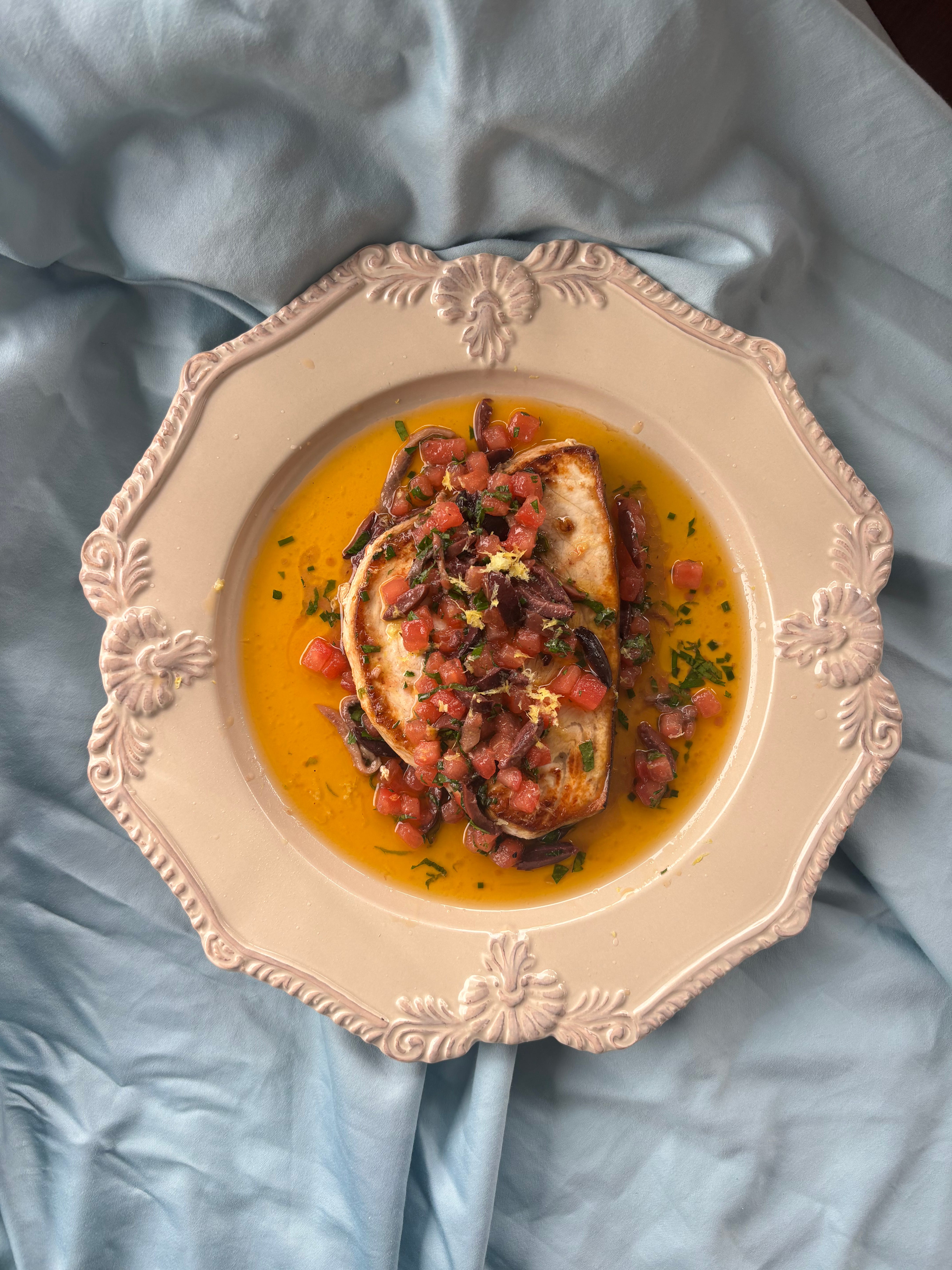
I’m not sure why swordfish isn’t more popular. I love the steakiness of it. Today I bought a nice mid-thick swordfish steak, gently soaked it in gin and lime juice, grilled it to 60 degrees like a medium-rare and topped it with a sauce vierge. There’s a lot of sensory satisfaction in concasse tomatoes; the peeling of the skin, the way the knife rolls along the flesh and separates the pulpy guts. My version of a vierge is made with tomato, kalamata olives, anchovies sliced lengthways, parsley, minced chives, chiffonade mint, lemon zest, EVOO, salt and pepper. Not winning any hats anytime soon but something soulful about rustic home cooking that tingles the gullet.
I’ve always loved eating out but I wasn’t always into cooking. In fact, I never was terribly domesticated until recent. I spent most of my 20’s aloof and peripatetic, traipsing between drug dens, music venues and urban haunts. My recall for shortcuts, public toilets, hidden parkland and tunnels is uncanny. I know a lot of names and faces from familiar train lines, apartment towers and other nefarious enclaves. After living in Sydney for a few years, I returned to Melbourne and never realised how much it had changed. My mental Rolodex of retail stores and restaurants had gathered dust, like cheap old plastic Christmas decorations waiting for a fruitful future that never comes. David and Camy’s in Box Hill disappeared, so did the Reach WCA piece at Victoria Park. Many of those familiar names and faces have disappeared for better or for worse, once-was staples of the urban ecosystem that just become holograms of data in the eternal screen of 1s and 0s that is memory.
I moved in with a girl I was dating haphazardly at 23 years old, something I fell into but selfishly figured would cure my rogue streak. The idea of domestication made me anxious, having to dissolve my calm veneer and frenetic undercurrent in order to commit, to relax, to breathe. I smoked an acreage of choof everyday in my 20s, and most stoners I knew were domesticated in the sense that they were practically glued to their smoke-stained couches, yet I could never reach such stillness. All marijuana did was somewhat quell my racing mind, and allow it to cling on to random fleeting interests like old library records, Baudrillard and Shark Tank on TV.
Some years later, when I was living in a share-house in Clifton Hill and started properly attempting to cook, I started to peer through the cracks of my nomadic shell, and stare into a portal previously unknown; a world in which you can decorate your apartment, exist in it comfortably and temporarily absolve yourself of external commitments. It has taken me moons to properly transcend. I had a girl come over to my apartment in Potts Point a couple of years ago and she made a quip that it looks like no one actually lives here. It was funny at the time, She’d have had a fright if she saw some of my previous dwellings though. Slowly I came around to the art of chilling at home and doing fuck all. Feels good.
Home cooking is a totally different kettle of fish to the real deal gritty chef life. You don’t need to fire that sea urchin pasta in 5 minutes. You can listen to Red Scare or Tim Dillon while you cook if you want. You can make steak tartare in your underwear and eat it on the couch, remnants of Pafritas truffle chips and yolky beef spilling on your Uniqlo t-shirt. Just as you deserve. There’s a beautiful focus that comes with home cooking, in the midst of sequential activity you find a peaceful rhythm. As long as you don’t mind doing the dishes.
Home cooking has also become a huge business, but is it technically part of the hospitality industry? Not really, yet it runs in close parallel. Private chefs have been in the shadows of the hospitality industry for a long time. There’s a friend of mine, a mother of two, an excellent chef who did away with the Michelin-starred life and just started cooking for the uber-wealthy in Sydney and on various private jets. She said most decent chefs she knows wouldn’t set foot in a commercial restaurant anymore unless they were front of house wining and dining.
Cooking on social media has been around since the inception of the platforms but Covid-19 was an accelerant, with the arduous lockdowns having a whoosh effect on the rise of the home cook/social media cook. At one stage, it felt like everyone you knew was making sourdough bread at home. I’m also one of those people that posts their half-pie attempts at cooking nice food, just because I can. My feed is a rich tapestry of whatever the fuck I was feeling at the time.
I’m sure you can hear the faint snarls of the purists, those who’ve slaved in steamy kitchens for years on end with no recognition, cooking food of the highest order, delighting the masses from the shadowy depths. I feel their plight and I admire it. I hear them diss these Instagram cooks, they feel as if they owe dues. Yet, I also quite admire this new crop of people who’ve managed to parlay social media presence and quality cooking into an income stream. I’m not generally a fence-sitter but I’m planted on the palings here. You’ll never replace the restaurant experience, you can’t eat through your screen just yet, but why not soak in a few Adam Byatt cooking demos in between.
At the end of day, I just enjoy culinary excellence, I’m not terribly biased on how it’s delivered. Sure, Instagram cooking reels are essentially delayed gratification cut and packaged into instant gratification, as you watch a dish get prepped in a series of half second chops that eventually climaxes as a finished plate, but you can also learn a lot of techniques. I’m a big supporter of the average person becoming better at cooking, eating less biohazard slop and eating more whole ingredients. Less Uber Eats and more cooking for yourself. I’m a big supporter of families that eat together at a table, and friends who pot-luck. Online cooks tend to cook more approachable and wholesome fare that appeals to the followers. Not everyone is trying to be Heston.
Sure, there’s a lot of piss-poor rage bait cooks and thinly-veiled socio pornography associated with online cooks that distorts the marketplace but is that not too dissimilar from the offline hospo world? Remember Salt Bae and his chain of steakhouses? Ever had pasta at the Sooshi Mango guys restaurant on Lygon Street? Remember Karen’s Diner in Sydney?
Trad-wife aesthetics crossing over into cooking is an interesting pocket of the online cookery world. Not just Nara Smith and Hannah Neeleman but there’s a real blue-blood everyday trad-wife community too. It’s hard to decipher whether it’s just pick-me energy, and pseudo-porn for guys who like traditional gender roles, given they’re now at more of a premium. Or, is it what I often suspect, a subtle flex on other women, the “look at my perfect little life” play. The over-engineered effortlessness. Same with really hot guys that cook and wear “slutty white t-shirts”.
Alas, when you zoom out, there’s a myriad of really cool people cooking on the internet and earning money from it. The Kiwi guy Andy Hearnden, an ex-chef, is doing numbers, I’m sure Paris Starn’s Substack is easily making more money than this one, and people like Laila Gohar are selling mother-of-pearl salad servers now. I fuck with the vision. Real wages are stagnant, fiat is off the gold standard and the neon-lit property casino is open 24/7. The meritocracy is over and we’ve crossed over into crony-capitalism, it’s time to listen to “Gotta Make it to Heaven” by 50 Cent and hustle.
Many pockets of the physical dining landscape are now downstream from the online world too, and vice versa. Ben Shewry makes potato salad on Instagram, you can watch Pierre Koffman make veal sweetbreads on YouTube. Everything’s starting to emulsify. People who got known for cooking from socials now do pop-ups and supper clubs. The aggregated dining landscape is widening to accommodate the online arc. Jung Fun Chae of Chae restaurant in her home is dripping in accolades of recent. Fashion brands have realised the power of food aesthetics as a commodity. It feels like Balboste was catering for every possible luxury house at one stage.
It runs deeper. You can now unpack dieting in a streamline manner on Instagram. “What I eat in a week on the Carnivore diet”… “Six simple mid-week vegan meals”… By sheer distortion of volume sometimes it all feels like slop. I gloss over 90% of it, but I think finding the cooks and social media personalities that speak to you on a different level is fun. The rabbit hole endures.
So as I sit down letting the mind wander after this lovely little swordfish, thinking about domestication and home cooking, I’m starting to wonder if the Homeless Industrial Complex is a thing? Remember when the council rounded up all the homeless people in Melbourne and put them in hotels while the Commonwealth Games were on in 2006? It’s taboo to question the homeless in the public discourse, but when do we start to unpack the difference between the various sects of the unhoused? If you really care about issues you want to dive deeper, you don’t just share some bullshit on your Instagram story.
There’s many people, particularly DV victims, stuck between the streets and shelters, yearning to get back on their feet. I also know a lot of guys with complex trauma issues who ended up on the streets because of severe drug addiction who I feel sorry for, a tragic affliction, yet many burnt every bridge on the way down. Many wouldn’t bother trying to claw their way back now anyway even if the helping hand was there. There’s two sides to every coin toss.
I would also say the majority of the people I know who live in social housing commission flats were not born in the system, but rather landed there by way of poor economic decisions and once again, complex trauma and severe drug addictions. Most people I know who’ve made money in Australia are from lower and middle class origins, a faint ray of hope for socioeconomic mobility in a system that gets murkier by the minute.
I’m starting to believe the cause and subsequent solutions for the homeless community has less and less to do with actual homes. It’s currently bundled in with the wider housing crisis but yet in my lifetime, nothing much has really changed. True charities exist to help at the point of crisis which is great, but why do we try to fix this issue only at the crisis point? The bigger picture itself never seems to get any better.
The middle class is still being sold the same old pipe dream of “work hard and you’ll get ahead” with no real specifics, as housing prices and the CPI have long decoupled from real wages. It makes me experience a sort of sombre gratitude. As hard as I work, I’m also somewhat blessed to have a roof over my head and four walls in which I can chill and do fuck all in. I can safely cook a Venetian duck ragu in my underwear and watch Tsai Ming Liang films if I want to.